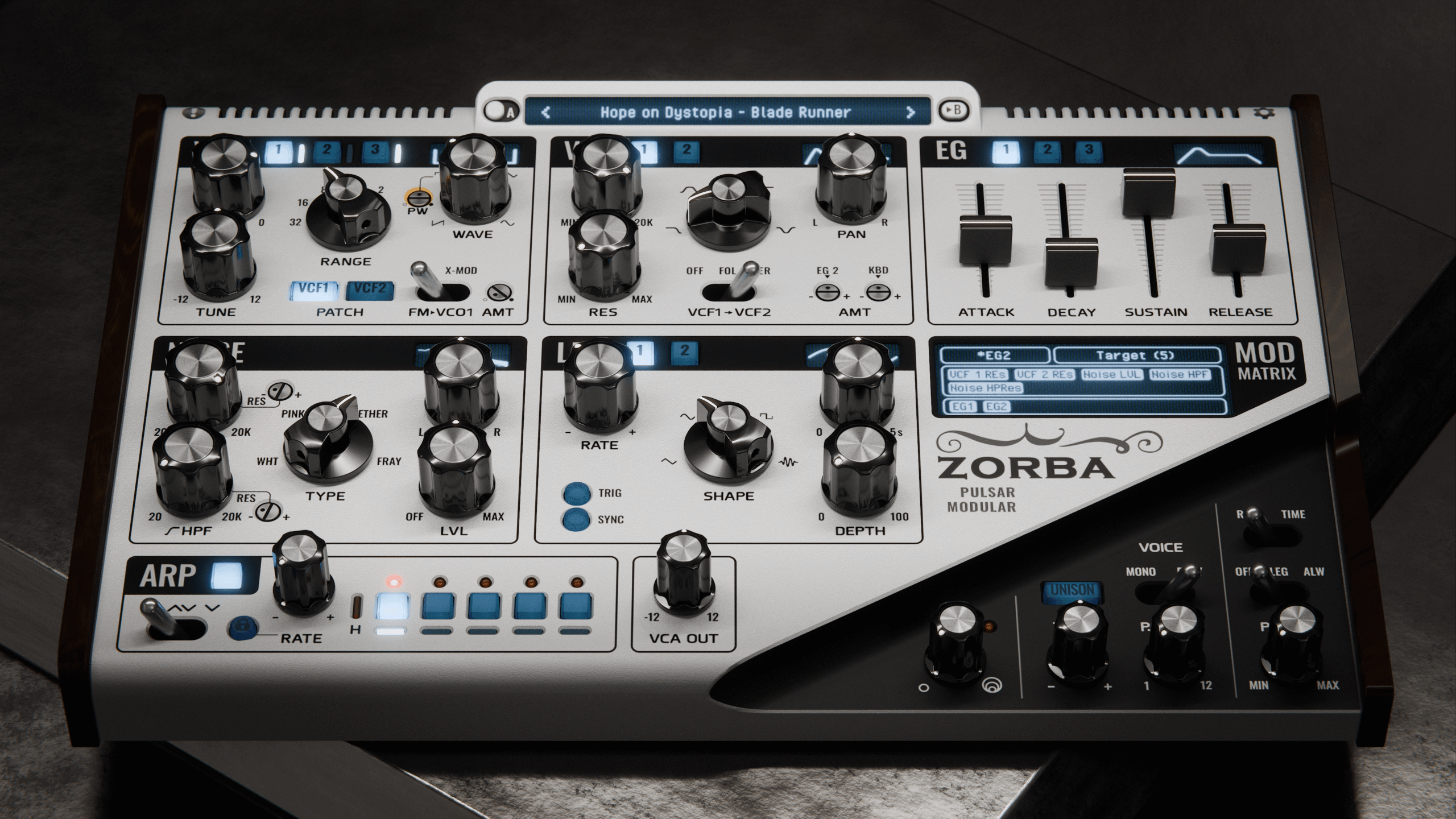
Zorba is currently the only software synth that matches naturally with my vintage analog collection. (Moog, Sequential, Roland, Andromeda)
Zorba has that extra dimension I usually only find in hardware. Magical, powerful, smooth and wide.
Built on the Pulsar Modular P900 analog heritage, Zorba can be a Juno on your first patch, a Jupiter on your second, and something neither could have imagined on your third.
Acquire Zorba this month and we'll add the P930 Lunar Lander ($180 value) to your cart, free. No code, no extra step: it appears automatically when Zorba is added.
Not eligible if you already own P930 Lunar Lander.
VCO1 and VCO2 share a single morph knob that slides continuously between saw, square, triangle, and sine. VCO3 is a fully independent sub oscillator reaching one octave below the main pair, with its own tune, gain, and filter routing.
Two independent filters based on the 904-F State Variable design. Low-pass, band-pass, high-pass, notch, each with a resonance curve that passes through clean, self-oscillation, transformer saturation, and the Black Hole rebirth zone.
Ten sources reach 38 unique targets across the synthesizer. Every route has its own depth. Multiple sources can share a target and combine. No slot limits, no setup fee for getting started, the defaults make Zorba musical the moment a key is pressed.
Zorba started from a simple question: what would a synthesizer sound like if it carried the warmth and soul of classic analog machines, but wasn't boxed in by their original architecture? The Junos, Jupiters, Prophets, and Moogs all made brilliant compromises in oscillator count, modulation paths, and envelope destinations. Those constraints became their character, and that character became the sound of decades of records.
Today's soft synths can offer hundreds of parameters and unlimited routings. Zorba doesn't try to win that race. It tries to win on sound, and on the focused depth that only emerges when an instrument has a clear voice.
The signal path honors the Pulsar Modular P900 analog heritage. Both filters share the same 904-F State Variable design. The noise generator runs on its own path with its own HPF and LPF, so breath transients, BBD-style chorus haze, and organ key click sit on top of the main tone without being shaped by it.
The result is an instrument that's immediate. Load a preset and play. Reach for the mod matrix and go as far as the routing will take you. Welcome to Zorba.
A single knob on VCO1 and VCO2 slides continuously between four shapes. The Hybrid zone around 0.50 to 0.60 produces bright odd-harmonic tones that no fixed-waveform synth can reach. Itself a mod target, route EG3 here for a reverse-brightness bloom.
Linear FM stays stable up to high amounts at common ratios, ideal for bells, electric pianos, and brass edge. X-MOD opens exponential, inharmonic territory, the sound of the Jupiter-8 Cross Mod. VCO2 keeps modulating even when removed from the audio mix.
WHT, PINK, ETHER, FRAY. The noise generator never passes through VCF1 or VCF2, so its character stays independent of filter cutoff. Critical for breath transients, BBD chorus haze, and organ key click that need to sit on top of the main tone.
Three positions tie the two filters into split-mode independence, locked-cutoff parallel motion, or a serial VCF1 to VCF2 audio chain. Each unlocks a different vocabulary, from stereo dual-timbre patches to LP into HP windowing and double-filtered vocal formants.
EG1 is hardwired to the VCA, EG2 to both filter cutoffs with a separate amount knob on each panel. EG3 is the free envelope, assignable in the matrix to 26 targets including FM Amount, waveform morph, resonance, noise level, and oscillator pitch.
LFO1 is always MONO for unified vibrato across all voices. LFO2 switches between MONO and POLY, the latter giving each voice its own LFO phase for organic per-voice scatter in pads. Both reach 26 targets including continuous cyclical waveform morphing.
An accent pattern of 1 to 5 steps with OFF, HALF, FULL per step. Loops independently of the held chord, so a 3-step accent over a 4-note chord takes twelve notes to return. Arp Accent is itself a mod source reaching 16 targets for rhythmic emphasis.
A single Plate Decay knob takes the space from 0.47 seconds out to 9.31 seconds. Wet/dry balance is internally calibrated so the reverb stays coherent through the full range. Set the knob to zero to bypass entirely when an external reverb is preferred.
Zero sample delay and no plugin delay compensation, so it tracks keys to notes with nothing in between, like real hardware. No convolution anywhere in the signal path keeps the CPU footprint low. Stack instances without thinking about it.
Sound design demos straight out of Zorba. Pads, leads, basses, FM textures, polymetric arpeggios, plate-reverb space. No external processing.
From Pulsar Modular on SoundCloud. Open the full playlist for the originals.
Zorba is currently the only software synth that matches naturally with my vintage analog collection. (Moog, Sequential, Roland, Andromeda)
Zorba has that extra dimension I usually only find in hardware. Magical, powerful, smooth and wide.
This is really incredible !
I own a lot of virtual synths and my reactions to the first test of this beast has been really funny :-)
You know all those VSTs with sounds full of “makeup” like chorus, reverbs, delays etc…
This one is dry…no makeup…but it sounds real !A beautiful lady with analog rough character .
No need to makeup, but put a reverb on it and you are in pure heaven !
It also has its beautiful Plate reverb too if needed :-)
It sounds organic and it can have different personalities .
I have to say that in my studio I have different analog synthesizers (Moog,Oberheim,Dave Smith,Korg,Roland …etc) so I know what I am talking about .
Guys you made a masterpiece ,the wait was really worth it ,thank you for your precious work !
Reviews can only be submitted by registered users. Please sign in to share your experience with the ZORBA Mono & Polyphonic Soft Synth.
User guides in three languages, the interactive Quick Guide, and the community preset submission form for the growing Zorba preset library.
Hover any knob, switch, or button on a working panel and read what it does. The fastest way to learn Zorba inside out before opening the plugin.
Submit your own .ZRBPreset files, browse community-approved patches, and join the Discord library channel. Categorized across 14 sound-design domains.
For users with an existing license. New buyers receive their download link by email after purchase.
Click DEMO, complete checkout for $0, and receive your authorization code by email. Fully functional on 2 computers.