

Zorba is something special. It sounds amazing even without processing, and the interface is clean and effortless-no unnecessary complexity. I only had the demo but I'll be buying it as soon as I can afford it. One of the few software synths that truly rivals hardware.
ZORBA
Forty years of analog DNA. One instrument.
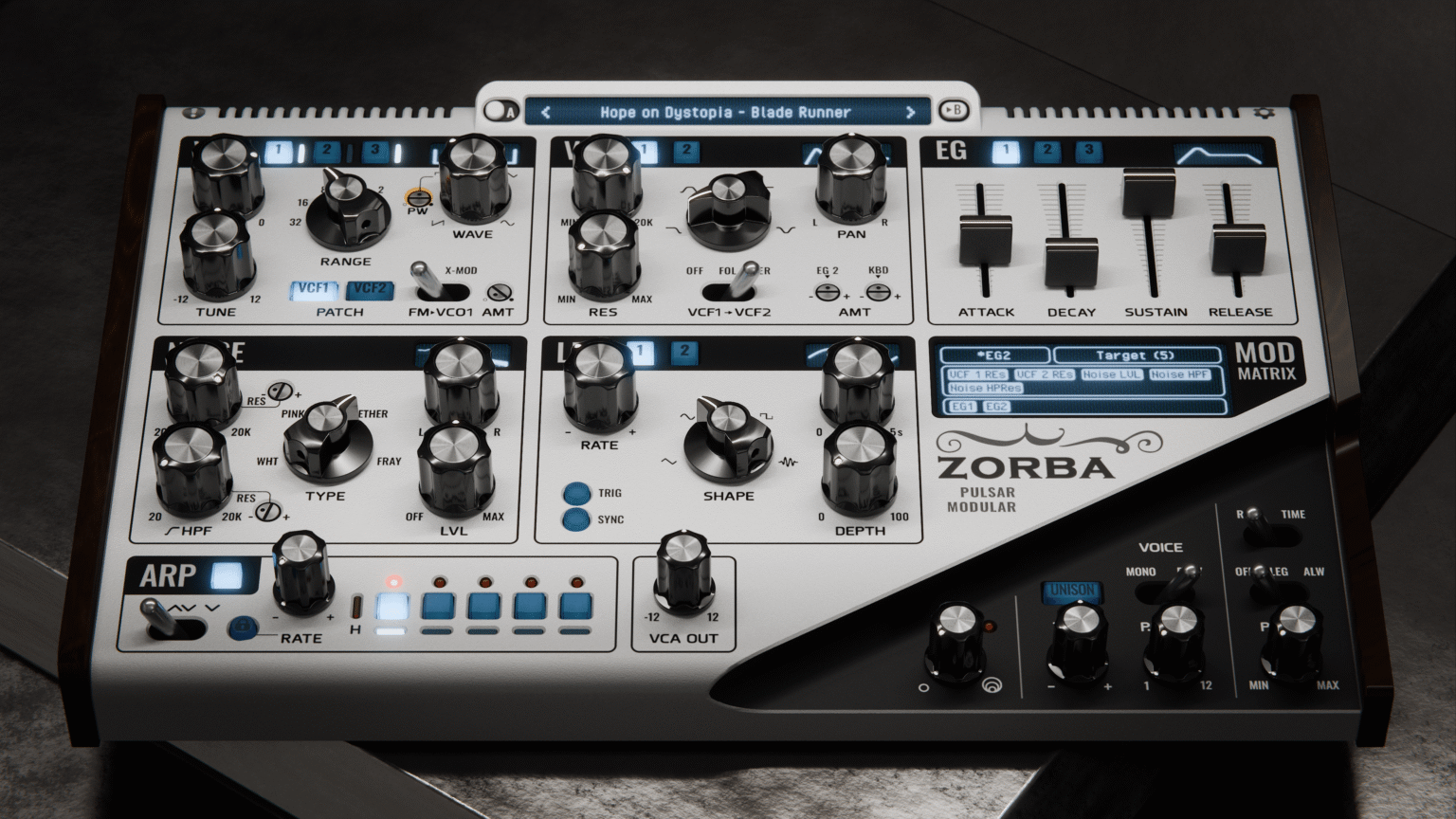
Built on the Pulsar Modular P900 analog heritage, Zorba can be a Juno on your first patch, a Jupiter on your second, and something neither could have imagined on your third. Three oscillators, two filters, three envelopes, two LFOs, an arpeggiator with accents and a modulation matrix that connects almost anything to almost anything else.
Purchasing and the free trial are paused until the next version ships.
Forty years of analog DNA, one signal path.
“The result is an instrument that can be a Juno on your first patch, a Jupiter on your second, and something neither could dream of on your third. All of it built on a signal path that honors the Pulsar Modular P900 analog heritage.”
Ziad Sidawi, Zorba designer, preface of the user guide
Three oscillators start the sound. VCO1 and VCO2 morph continuously from saw through square and triangle to sine, with FM between them in a linear and a cross-mod flavor, and VCO3 is an independent sub an octave below with its own tune, gain and filter routing. The noise generator runs on its own path with its own filters, so breath, key click and chorus haze sit on top of the tone instead of being shaped by it. Two filters share the 904-F state variable design, low-pass, band-pass, high-pass and notch, with a resonance that travels from clean through self-oscillation and saturation into the Black Hole zone, and they run independent, linked or in series.
Three envelopes, two LFOs and an arpeggiator with a five-step accent pattern feed a modulation matrix of twelve sources and 38 targets, 208 routes with no slot limits and defaults that make the first patch playable before you touch a thing. A plate reverb sits at the end, from a tight room to a long decay. Zero samples of latency and no convolution anywhere keep it feeling like hardware and light on the CPU, so instances stack without a second thought. MIDI-Learn, polyphonic aftertouch and a breath source cover the performance side.
- OSCILLATORS · FM
- Continuous waveform morph on VCO1 and VCO2 with a Hybrid zone no fixed-waveform synth reaches; linear FM for bells and electric pianos, X-MOD for the exponential, inharmonic territory; hard sync; four noise types on an independent path.
- FILTERS · COUPLING
- Two 904-F state variable filters: low-pass, band-pass, high-pass and notch, resonance from clean through self-oscillation and transformer saturation to the Black Hole zone. OFF, FOLLOW or SERIES ties them together.
- MODULATION · ARP
- Three envelopes, two LFOs, an arpeggiator with a five-step OFF, HALF, FULL accent pattern that loops independently of the held chord, and the matrix that connects them: 12 sources, 38 targets, 208 routes.
- REVERB · PERFORMANCE
- A plate reverb from 0.47 to 9.31 seconds, zero to bypass. MIDI-Learn with saved mapping sets, polyphonic aftertouch into a single held voice, a dedicated breath source, glide with its own modes and types.
Videos.
What owners say.
Hello,
I’m a sound junkie and a hardware freak.
Plugins that emulate "analog synthesizers" used to be a no-go for me. But when the P900 came out, I was surprised by the sound—
and now I’m thrilled with Zorba.
Best of luck to the team!
Zorba is currently the only software synth that matches naturally with my vintage analog collection. (Moog, Sequential, Roland, Andromeda)
Zorba has that extra dimension I usually only find in hardware. Magical, powerful, smooth and wide.
This is really incredible !
I own a lot of virtual synths and my reactions to the first test of this beast has been really funny :-)
You know all those VSTs with sounds full of “makeup” like chorus, reverbs, delays etc…
This one is dry…no makeup…but it sounds real !A beautiful lady with analog rough character .
No need to makeup, but put a reverb on it and you are in pure heaven !
It also has its beautiful Plate reverb too if needed :-)
It sounds organic and it can have different personalities .
I have to say that in my studio I have different analog synthesizers (Moog,Oberheim,Dave Smith,Korg,Roland …etc) so I know what I am talking about .
Guys you made a masterpiece ,the wait was really worth it ,thank you for your precious work !
Sign in to write a review
Reviews can only be submitted by registered users. Please sign in to share your experience with the ZORBA Mono & Polyphonic Soft Synth.
Downloads.
Hover any knob, switch or button on a working panel and read what it does. The fastest way to learn Zorba before opening the plugin.
Submit your own .ZRBPreset files and browse community-approved patches, categorized across 14 sound-design domains.
- MIDI-Learn with full mapping management (save / load / default sets)
- Polyphonic Aftertouch: per-voice source with 20 destinations
- Breath Controller: new dedicated breath source
- Modulation matrix expanded to 208 routes (up from 174)
- VCO frequency range extended from 12 to 48 semitones
- EG attack now starts at 0.11 ms instead of 0.05 ms for a punchier initial transient
- Fixed: H-SYNC now tracks correctly with the extended VCO frequency range
- Fixed: VCO no longer phases when placed in a morph position
- Fixed: VCF cutoff frequency point no longer misfires after a position change
The technical bits.
Thirty days on two computers.
Fully functional, no card required. Start the demo, complete the checkout and your authorization code arrives by email.
Already tried Zorba and ran out of time? Email us through the support page and we will reset your trial.
Yours, on two computers.
One license, two computers, no dongle. Your authorization code arrives by email.
Zorba v2 is coming.
Purchasing and the free trial are paused until the next version ships. Existing owners can keep using Zorba and download v1.1.3 from the Downloads section.
Zorba is not a clone of any single instrument. Juno, Jupiter, Prophet and Moog belong to their respective owners; the names describe the lineage.
AAX and Pro Tools are trademarks of Avid Technology, Inc. Audio Units is a trademark of Apple Inc. VST is a trademark of Steinberg Media Technologies GmbH. All other trademarks are the property of their respective owners.
