

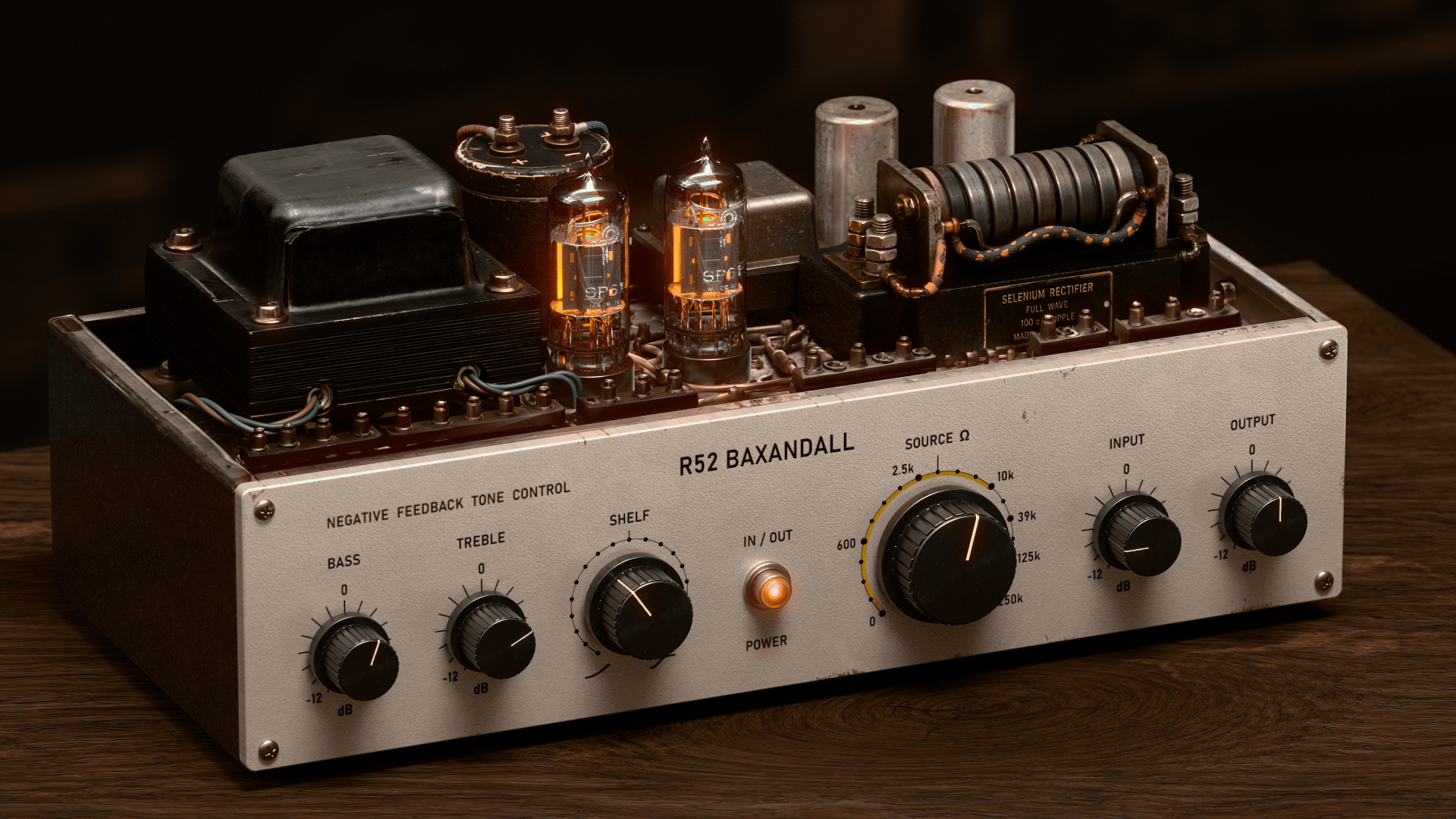
The original network. A treble lift that keeps climbing to the top of the band, and a bass shelf that keeps growing beneath the notes, into pure weight. The circuit the rest of this page describes, and the one to reach for when you want the instrument's full reach.
R52 Baxandall
The 1952 circuit, as Peter Baxandall published it.
In October 1952, Wireless World printed a two-knob tone control with the EQ network inside a valve amplifier's feedback loop. The industry kept the shape and redrew everything else. R52 is the circuit itself: the SP61 pentode in the loop, the published component values, and the conditions Baxandall specified around it, source impedance and the amplifier at the far end, now under your fingers.
We rode together before.
We shared the journey.
Leapers, are you ready?
- R52 is currently targeted for release in late September.
- Offer ends at release or when available slots sell out, whichever comes first.
$49 per license, 51% off the $99 retail price. Paid in full at checkout; installment plans are not available on this offer and it cannot be combined with any other discount. The offer closes at general release, targeted late September 2026, or when the allocation sells out, whichever comes first.
Release date to be announced. The 30-day demo and the installers open on release day.
The Leap of Faith allocation is gone. R52 arrives in the store in late September; the demo and the installers open on release day.
A revival, not a revision.
R52 is a revival, not a revision. Peter Baxandall published the design in Wireless World in October 1952, and what began on those pages became one of the most influential circuits in audio. Yet, the industry adopted only its shape, redrawing the circuit to fit commercial realities rather than the conditions Peter specified.
Three quarters of a century later, we returned to the source, rebuilding the circuit and the conditions that defined it. This is that circuit.
One network, not two bands.
BASS and TREBLE are two arms of one feedback network, so each changes what the other is working against. Lift both and the middle steps back; cut both and it comes forward. The SCOPE draws the interaction as you move.
The amplifier is inside the EQ.
The valve is not a saturation stage bolted on after the filter. It sits in the loop the curve is made of, so level is part of the sound: INPUT decides how much valve you hear, and a treble lift works the valve exactly where you lifted. Quiet is clean, loud is colored, and there is no clipping point in between.
The conditions are under your fingers.
In 1952 the source impedance and the amplifier at the far end were fixed by whatever hardware you owned. R52 puts them on the panel. SOURCE sets what feeds the network, LOAD sets how tightly the amplifier grips a 15 Ω monitor, and SHELF chooses between the two treble endings Baxandall published.
-
October 1952
Negative-Feedback Tone Control, Wireless World. The complete circuit: the valve, every component value, and the reasoning.
VERSION 1952 -
November 1952
His correction, carrying the alternative shelving arrangement. On R52 it is the clockwise end of SHELF in the 1952 circuit.
SHELF -
January 1955
His next design puts the rising-or-shelving choice on a front-panel switch, left to the builder.
-
May 1957
Inexpensive Pre-Amplifier, page 209. The network redrawn for gain on an ECC81 triode, filed under preamplifiers and almost never built.
VERSION 1957 -
September 1974
Baxandall tone control revisited. The trade press draws the circuit as a bare triangle, calls it “the almost universal choice”, and cites neither paper.
-
1976
BBC Research Department Report 1976/29 on the LS3/5A. Harwood's seven-ohm remark, published but never adopted.
LOAD 7.0 Ω
Two circuits, three positions.
VERSION replaces the circuit itself, and the difference between the two networks is larger than anything the tone controls can do. The later network offers a choice of valve.
His later network: redrawn values and an added component with no counterpart in the original. The treble becomes a presence control, roughly a third of 1952's lift at the same knob position, and the bass turns over into a defined hump on the fundamentals with the mud pulled out below.
The 1957 network with the 1952 valve swapped in. Same punch and presence, tighter low end: the front of a bass note keeps its articulation where 1957 thickens it. Baxandall never built it. It is an R52 extension, kept because it widens what the instrument can do without touching the published network.
From the desk.
Videos.
What owners say.
Sign in to write a review
Reviews can only be submitted by registered users. Please sign in to share your experience with the R52 BAXANDALL.
The technical bits.
/Users/Shared/Pulsar Modular/R52 Baxandall/Presets on macOS, C:\Users\Public\Documents\Pulsar Modular\R52 Baxandall\Presets on Windows. A preset named Default loads on every fresh insert.Thirty days, no commitment.
Fully functional on two computers, no card required. Your authorization code arrives by email.
Already tried R52 and ran out of time? Email us through the support page and we will reset your trial.
The circuit is yours.Leapers, welcome back.
One license, two computers, no dongle. Your authorization code arrives by email.
Coming very soon.
The 1952 circuit is nearly ready. The 30-day demo, the installers and the user guide open on release day.
This round is closed.
The Leap of Faith allocation is gone. R52 arrives in the store in late September.
R52 Baxandall is not affiliated with, endorsed by, or connected to Peter Baxandall or his estate, nor with any commercial Baxandall-derived product. No commercial equipment was targeted or measured in its development; R52 was built from Peter Baxandall's published articles in Wireless World (January 1948, October 1952, November 1952 and May 1957) and the other primary sources listed in the user guide. “Baxandall” is used as the standard term for the circuit topology, the way the audio trade has used it since at least 1974.
Wireless World, the BBC, LS3/5A and all other company, publication, product and personal names appearing on this page are the property of their respective owners and appear for historical reference only. AAX and Pro Tools are trademarks of Avid Technology, Inc. Audio Units is a trademark of Apple Inc. VST is a trademark of Steinberg Media Technologies GmbH.
