
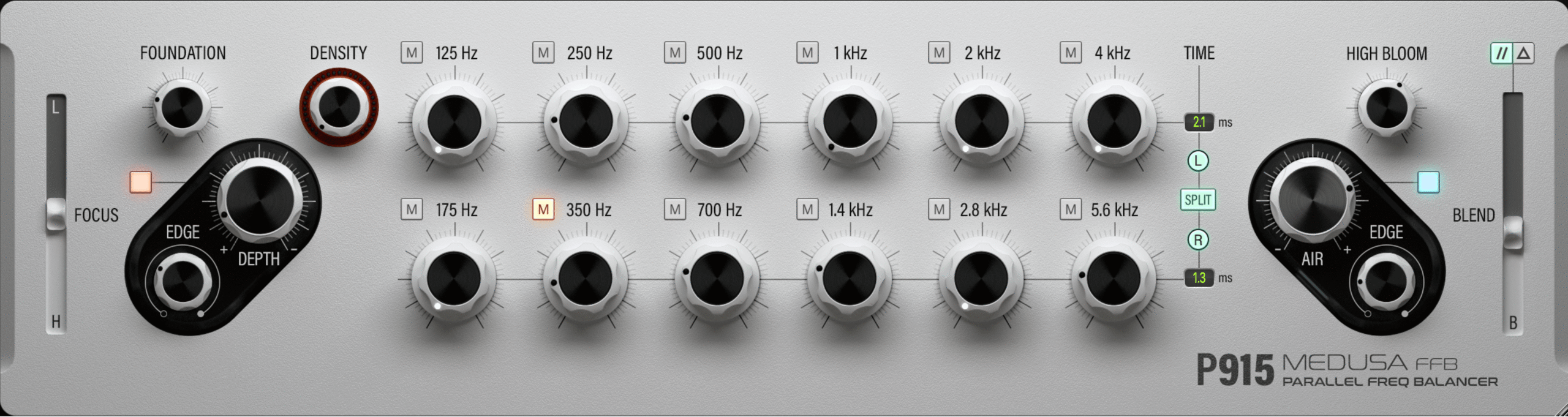

"P915 Medusa is a spectral suggestion engine. It adds density and air that helps a master translate without compromising phase, transients, or headroom. When a master tells the truth but needs to feel complete, P915 Medusa knows where to whisper."
MAT LEFFLER-SCHULMANMastering Engineer (Dan Deacon, Jon Batiste, Maya Angelou, Teen Mortgage, Jackson Dean) 
"Been using it on recent mastering sessions and absolutely love what it can do especially in the high end and the sense of dimension it adds without losing focus. Might look like an EQ but it’s nothing like an EQ!"
ADHAM FARIDMASTERING & MIXING ENGINEER, PRODUCER (SELIN, UZI, AKSAN, MOTIVE, DA POET) 
"P915 Medusa might be the most inventive plugin I’ve used in a long time. Dropping it on the mix bus once a mix is finished takes an already great mix somewhere I wouldn’t have reached otherwise."
CRAIG BAUERGrammy Award‑Winning Mixing Engineer (Ed Sheeran, Rihanna, Justin Timberlake, Lupe Fiasco, The Clark Sisters) 
"P915 Medusa is a fantastic tool for adding clarity and character without sacrificing the original tone. The parallel workflow lets you push the effect harder while keeping the result natural and balanced, with full low end, warm mids, and airy highs without harshness."
RAZIK MASTERINGProfessional Analog Mastering 
"P915 Medusa is a fast, musical betterizer. DELTA makes it easy to hear exactly what it is adding while you dial in tight low-end punch and an open, lively top end, then switch back to Parallel for an instantly more finished mix."
FARZAD "FARZI" RAHNAVARDMixing & Mastering Engineer - Duo Mastering (Cro, Shirin David, Shindy, KC Rebell) 
"EDGE is a standout feature. It gives the extremes a clear limit and a more decisive tone, and the filter frequency choices are spot-on across genres. An excellent tool that deserves a place in any mastering arsenal."
ALESSANDRO PICCIAFUOCHIMixing & Mastering Engineer (Robert Miles, Satoshi Tomiie, Alex Neri) 
“Medusa delivers the kind of tonal shifts I normally reach for saturation to get, but with far more control. DELTA makes it instantly clear what is being added so you can shape the exact areas you want.”
ALLAN KLINBAIL Mastering Engineer (Ranjit Nijjer, Raging Moby, Ivofonic, Morion) 
“Wow! The soundstage popped, like clearing your ears after a flight. Suddenly there was space and openness, without smearing the mix in artificial reverb haze.”
GARRETT HAINESAward-winning mastering engineer and senior contributor, Tape Op Magazine 
“The P915 isn’t just a parallel EQ. The Density control allows you to introduce compression-like behavior without the usual artifacts that can be problematic in mastering.
Rather than narrowing the workflow, P915 opens up spectral dynamic possibilities that aren’t easily achieved with conventional tools.”
NURETTIN "F.C MASTERING" ÖZDEMİRMastering Engineer 
“The last thing I needed was another EQ, but the Medusa is different. This spectral balancing beast has surprisingly made its way onto a bunch of my masters and I've only had it for a couple of weeks. I keep finding new ways on how to make this plugin work for me.”
JOSEPH CARRÁGrammy Nominated Mastering Engineer 
“I really enjoy using the P915 MEDUSA plugins. I mainly use them on group buses and consistently achieve excellent results that truly convince me. They integrate smoothly into my workflow and help bring clarity to my mixes. A very strong and helpful tool!”
SERHAT SAKINSONGWRITER, PRODUCER & MIXING ENGINEER (ESTELLE & KANYE WEST, JOHN SUMMIT, DAVID GUETTA, ROBIN SCHULZ, BIA, SOFIA CARSON & J. BALVIN) 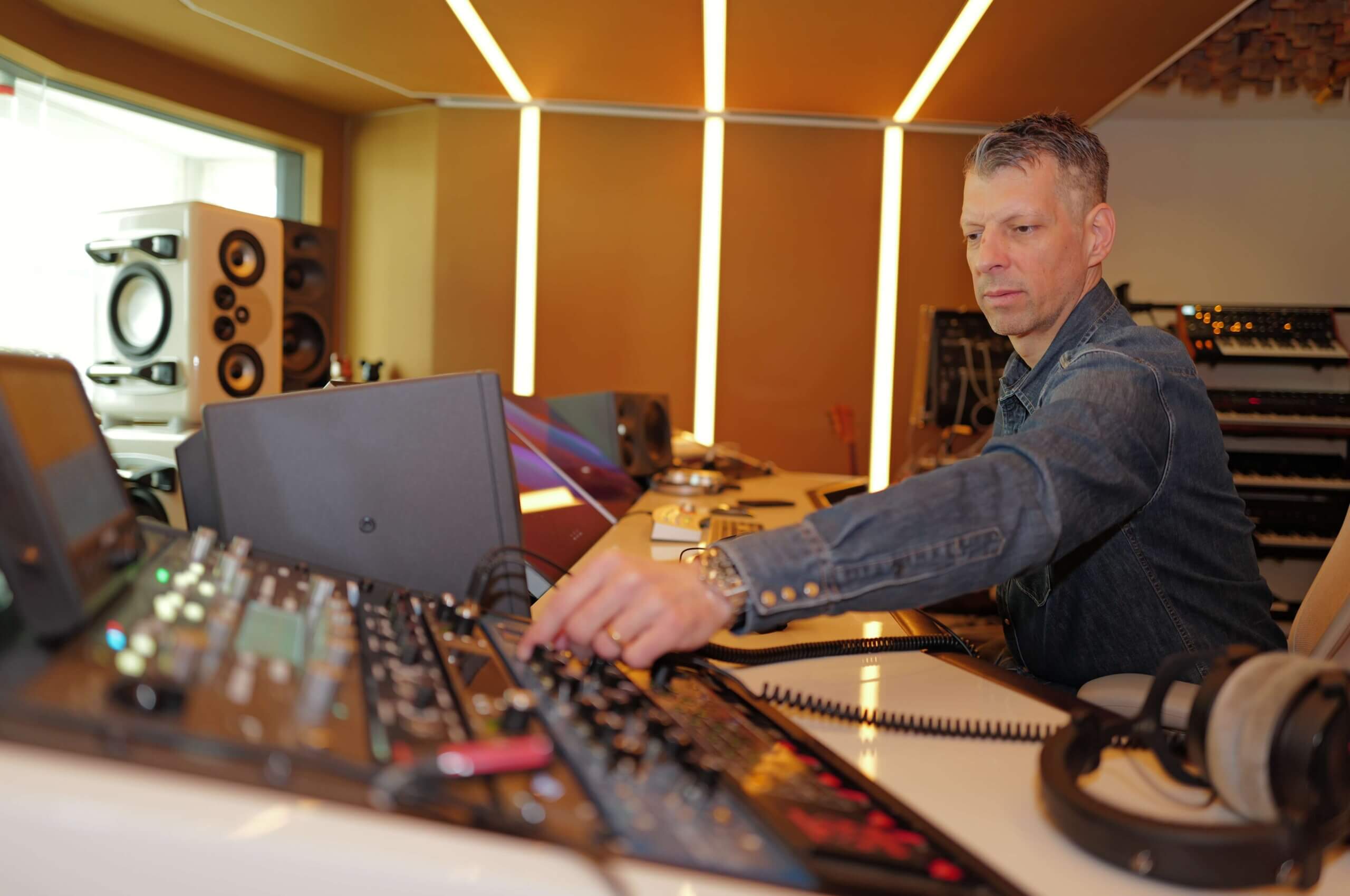
"P915 Medusa is a spectral suggestion engine. It adds density and air that helps a master translate without compromising phase, transients, or headroom. When a master tells the truth but needs to feel complete, P915 Medusa knows where to whisper."
MAT LEFFLER-SCHULMANMastering Engineer (Dan Deacon, Jon Batiste, Maya Angelou, Teen Mortgage, Jackson Dean)
"Been using it on recent mastering sessions and absolutely love what it can do especially in the high end and the sense of dimension it adds without losing focus. Might look like an EQ but it’s nothing like an EQ!"
ADHAM FARIDMASTERING & MIXING ENGINEER, PRODUCER (SELIN, UZI, AKSAN, MOTIVE, DA POET)
"P915 Medusa might be the most inventive plugin I’ve used in a long time. Dropping it on the mix bus once a mix is finished takes an already great mix somewhere I wouldn’t have reached otherwise."
CRAIG BAUERGrammy Award‑Winning Mixing Engineer (Ed Sheeran, Rihanna, Justin Timberlake, Lupe Fiasco, The Clark Sisters)
"P915 Medusa is a fantastic tool for adding clarity and character without sacrificing the original tone. The parallel workflow lets you push the effect harder while keeping the result natural and balanced, with full low end, warm mids, and airy highs without harshness."
RAZIK MASTERINGProfessional Analog Mastering
"P915 Medusa is a fast, musical betterizer. DELTA makes it easy to hear exactly what it is adding while you dial in tight low-end punch and an open, lively top end, then switch back to Parallel for an instantly more finished mix."
FARZAD "FARZI" RAHNAVARDMixing & Mastering Engineer - Duo Mastering (Cro, Shirin David, Shindy, KC Rebell)
"EDGE is a standout feature. It gives the extremes a clear limit and a more decisive tone, and the filter frequency choices are spot-on across genres. An excellent tool that deserves a place in any mastering arsenal."
ALESSANDRO PICCIAFUOCHIMixing & Mastering Engineer (Robert Miles, Satoshi Tomiie, Alex Neri)
“Medusa delivers the kind of tonal shifts I normally reach for saturation to get, but with far more control. DELTA makes it instantly clear what is being added so you can shape the exact areas you want.”
ALLAN KLINBAIL Mastering Engineer (Ranjit Nijjer, Raging Moby, Ivofonic, Morion)
“Wow! The soundstage popped, like clearing your ears after a flight. Suddenly there was space and openness, without smearing the mix in artificial reverb haze.”
GARRETT HAINESAward-winning mastering engineer and senior contributor, Tape Op Magazine
“The P915 isn’t just a parallel EQ. The Density control allows you to introduce compression-like behavior without the usual artifacts that can be problematic in mastering.
Rather than narrowing the workflow, P915 opens up spectral dynamic possibilities that aren’t easily achieved with conventional tools.”
NURETTIN "F.C MASTERING" ÖZDEMİRMastering Engineer
“The last thing I needed was another EQ, but the Medusa is different. This spectral balancing beast has surprisingly made its way onto a bunch of my masters and I've only had it for a couple of weeks. I keep finding new ways on how to make this plugin work for me.”
JOSEPH CARRÁGrammy Nominated Mastering Engineer
“I really enjoy using the P915 MEDUSA plugins. I mainly use them on group buses and consistently achieve excellent results that truly convince me. They integrate smoothly into my workflow and help bring clarity to my mixes. A very strong and helpful tool!”
SERHAT SAKINSONGWRITER, PRODUCER & MIXING ENGINEER (ESTELLE & KANYE WEST, JOHN SUMMIT, DAVID GUETTA, ROBIN SCHULZ, BIA, SOFIA CARSON & J. BALVIN)

P915 Medusa v2 refines the original design with improved circuitry, corrected curves, and a clarified workflow. Because of these refinements, v2 may not sound identical to earlier versions, but existing sessions will open normally. This is a free upgrade for existing users.


- An LED on the band dials to indicate when it is shut off for easy visualization.
- Fixed bug with modifier key combo.
- Official release.
Um, ok, so I just demoed this after watching some of your videos on the time shift function. I have to say, I’m not sure if there’s an easy way to recreate the subtle, mono-compatible enhancement that’s happening here, but if there is, I’d sure bet people would be talking about it. As another reviewer mentioned, you might think “it’s not really doing anything,” but rest assured, it is. Can’t wait to get my hands on the full version. I have a few projects that are due in a week, and I’ll be putting this on the master bus for some end-of-chain pixie dust. I just wish it had a little more control over the frequencies, but there’s enough here that I really don’t think it’s “lacking.” Just turn “Split” on, set the times a few ms apart, and start turning things up. Voilà! Oh, and the “Foundation” and “Depth” add a low end that quite honestly made me laugh out loud with glee when I first turned it up.
Pulsar Modular P915 is a real Swiss Army knife: versatile, practical, and surprisingly easy to use. Great for shaping sound fast without sacrificing control.
I loved the original version of P915 Medusa, using it both as a sound design tool and for mixing – things just sounded better with it. The reworked P915 is almost a different beast, with a focus on that final 5% on top of a “finished” mix that really makes good into great – and the new Medusa is fabulous sounding and rewards bold experimentation as much as subtle moves. I hope she continues to evolve, perhaps into a tool as equally at home during production as she is making the finished article even more alive.
At first I didn’t really gel with the P915 but after watching Ziad’s instructional video on the plugin I immediately saw how indispensable it would become for my projects. The chosen filters are excellent and I can really coax out tones I wouldn’t easily find with other tools. Many times I’ve been in a situation where I’ve been trying to solve a problem for a long time using EQs and filters and the like and nothing would work until I slapped the P915 on the project and everything would just fall into place after a few twists of a knob.
It is a really great tool to highlight elements in your mixes or just to bring more life to your instruments and even bring out an organic width to your mix. I really recommend getting this plugin even if it might not call to you straight away.
Don’t sleep on this plugin! It seems straightforward enough, but there is some magic in the filters! The tilt control was a great design idea, very useful. The resonance controls on the HPF/LPFs can help make musical choices. As others have said, the P915 excels on electric guitars, you can really build a wall of sound if that’s your thing!